
H2: Introduction
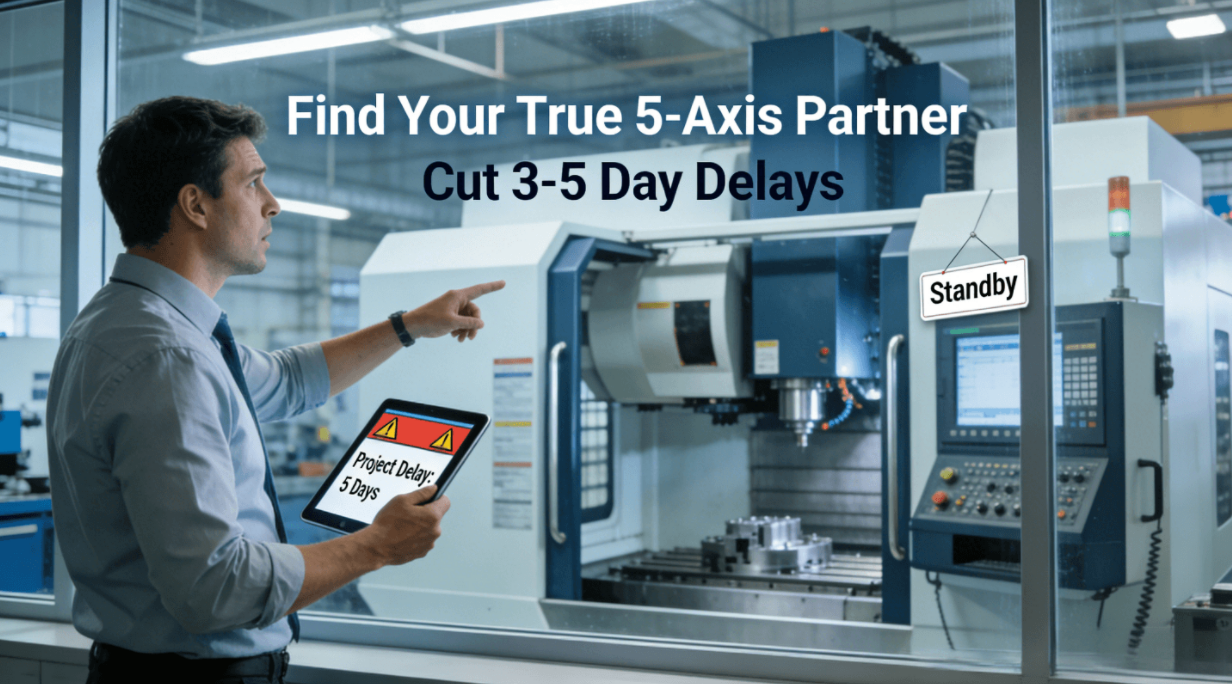
When a project requires immediate prototyping of a complex turbine housing or a medical implant, “5-axis CNC machining near me” becomes the go-to phrase. Unfortunately, the list of suppliers nearby may present quote differences of 40-60%, unclear delivery schedules, and once visited, you realize that most pieces of the machinery are hopelessly outdated. The risk of selecting “the closest one” usually leads to project delays for 3-5 days or even worse – the need to redo the entire project due to poor quality components.
This happens because conventional searches based on the proximity of the manufacturer and equipment lists address only the “geographical existence” of the supplier but do not measure its manufacturing capability and capacity to deliver quality products. It turns out that the traditional search strategy misses the intangible component of success, including process capability and quality assurance systems. Making the risk assessment of the partner purely geographic is the key factor behind the failure. This article presents an innovative “Four-Dimensional Assessment Framework of Local Partners” which addresses the issue of project success beyond mere “equipment availability.”
H2: Why Does “Closest on the Map” Often Mean the Furthest from “On-Time Delivery”?
A mistake that can easily occur when choosing a manufacturer is the sole focus on distance. A factory may be located closer but have a specialized capacity for large volume orders that are less sophisticated in nature. It does not possess the system capability for smaller volumes of highly engineered items, thus leading to internal priority issues and delays. On the other hand, a farther factory with an advanced rapid response cell and a project engineer will provide quicker delivery. Genuine flexibility in manufacturing comes from a system design perspective and organizational culture. As highlighted by the Society of Manufacturing Engineers (SME), creating flexible manufacturing cells and multidisciplinary teams proves to be a better approach for reducing lead times than distance. The key to avoiding this pitfall is to develop an evaluation methodology for scientific decision-making. A comprehensive reference tool, like a guide on selecting a local 5-axis CNC machining partner, offers a detailed checklist.
- The Incompatibility between Volume and Velocity: Most local machine shops are business models based on large orders that would be made within a longer time frame. Your rush and complicated prototype is an unwanted disruption in the otherwise smooth running of their processes. What may seem like the closest shop to take on your work will consistently give you trouble due to their business metrics focusing on machine hours utilized for bulk orders, rather than quick turnaround time and engineering iterations of yours. Thus, proximity becomes irrelevant to you.
- The Secret Bottleneck of Inadequate Process: An informal machine shop that claims its ability to deliver any type of order without having a proper project intake and management process is risky. Without a defined system for analyzing RFQ, reviewing the engineering drawings, and scheduling production time, the success of your project depends heavily on constant phone calls and the shop owner’s memory. An inefficient process becomes a hidden bottleneck for what could have been a short setback if only you partnered with someone else who has a set procedure.
- The False Economy of Shared Logistics: While “proximity equals ease of shipment,” this is a trap that might lead you astray. Should the shop you have chosen lack internal capabilities such as anodizing or tempering, you will be forced to move the item elsewhere to get that done; therefore, there is no benefit from the logistics angle here. Also, you should consider that the local shop may prove more chaotic in its operations and result in more deliveries for follow-up services than a professional distant company.
H2: The Art of Moving beyond the Machine Checklist: A Four Pillars Strategy for Assessing Real Capability
In order to find the right partner, you should not only refer to the brochure but also use a four pillars strategy. First, Technical Capability Verification assesses your partners’ capability using test cuts and CMM reports in order to verify the claim about precision. Second, Quality System Auditing goes beyond the ISO 9001 certificate and includes an audit based on FAIR reports and SPC data. Third, Response Speed Quantification provides specific numbers such as turnaround time and engineering cycle. And finally, Total Cost of Ownership Analysis considers logistics and other related costs.
H3: 1. Technical Competency: Proofread for Accuracy, Not Sales
Never take any list of machine makes as a confirmation of competence. Make your partner provide evidence. Your reliable partner will happily provide the machining of a sample part, which will include the necessary critical elements like thin walls, pockets, and intricate shapes. The result won’t be just a part but a detailed CMM inspection report comparing the product to its CAD model. This pragmatic approach allows differentiating between marketing buzz and real machining capabilities by giving you precise information on how they handle “sub-0.01 mm”.
H3: 2. Quality Management: Auditing a Living System
A quality certificate is permission to own the process, not an assurance of its effectiveness. In an auditing process, make your partner show you the first article inspection report of one of their recent, complicated projects. Verify that measuring equipment possesses valid calibration stamps. Find out whether there is a non-conformable materials control area and whether there are records of rework operations. This way, you will determine if quality management in machining is a live culture backed by a real-time document flow.
H3: 3. Response & Cost: Measuring the Intangible Variables
Measure the speed of response through a test exercise – send an RFQ request for a medium-complexity component and measure their response regarding the technical acknowledgment and quote. As for cost, prepare a total cost of ownership study. Calculate the costs associated with your internal team spending time on extended communications, expedited shipping of the components for revisions, as well as an additional risk premium in case of delayed delivery. In many cases, a more expensive local partner can offer a better total project cost through efficient systems minimizing hidden costs.
H2: “Test Cut”: What to Expect in Terms of Verifying Sub-0.01mm Tolerance Capabilities Before Ordering Parts?
The best test you have in your disposal when choosing among several partners is the test cut itself. It is a tangible evidence of the contract of sorts between your expectations and the results the supplier delivers. Send the supplier a detailed drawing of a component which includes such difficult features as high aspect ratio pockets, freeform geometries, and small position tolerances. Ask them for their CAM strategy simulation and a complete 3D scan or CMM report upon finishing the job.
H3: 1. Building the Diagnostic Part
Your diagnostic part should incorporate elements that can test various aspects of 5-axis machining: a thin, unsupported wall, a test for vibrations and deflections; a steep, deep pocket, which would test accessibility, reach and the ability to apply coolant; and, thirdly, a 3D contour, which would allow for testing the accuracy of surface finish and interpolation along various axes. With datum features in your part, your CMM report can show what geometric tolerances like flatness, perpendicularity, and true position capabilities your vendor has when it comes to building complex parts.
H3: 2. How to Interpret Evidence from Testing: The CMM Color-Map Deviation Report
In essence, the CMM report is the core of evidence-based testing. Do not simply seek a passing grade. Examine the data provided. Does the deviation exhibit a pattern suggesting systematic errors or even thermal distortion, or is it random? Is the surface finish uniform or does it display the characteristic signs of tool wear, such as machining marks? A reliable 5-axis machining shop will help you understand the meaning of those deviations and the steps taken by them to correct these defects.
H3: 3. From Test to Partnership: Establishing a Performance Benchmark
A successful test not only makes the supplier eligible but establishes a performance benchmark. The particular machining settings, tooling equipment, and testing process which have resulted in a successful test serve as a performance benchmark for your manufacturing project. This way, the test becomes the base for future successes, making sure that the level of precision achieved during the test is going to be maintained in your project.
H2: Can Their Quality System Survive a “Surprise Audit”? What to Watch Out for Apart from the Certification
No matter how perfect the quality system may be on paper, it needs to be put into practice every day to prove itself. In a surprise audit, as well as a very detailed review of the plant during a walk-through process, one must seek proof of an ongoing quality culture. Ensure that the control plan, and work instructions, that are currently followed on the machine are based on the latest revision of the drawing. See if there is an SPC chart measuring the critical dimensions being produced right now. If there is any automotive and/or medical manufacturing, then PFMEA and change control processes need to be visible.
H3: 1. The Gemba Walk: Observing Quality at the Shop Floor
Visit the shop floor (Gemba). Does the visual management system work well? Are the machines in order? Is there a designated space for inspecting the first article with appropriate equipment? Ask an operator how they perform the inspection procedure for the part being machined. It will provide insight into the level of process knowledge and quality control that is more significant than any document. Process discipline can be seen in order and visual management systems.
H3: 2. Following the Process of One Component Through the Entire Process Line
Take one part from the batch and obtain a full traveler or report for the piece. It should include certificates for materials, all inspections carried out per operation performed, and non-conformity forms if applicable. This is a good test of their ability to trace individual parts through all operations. This capability is essential for conducting any investigation of root causes. It is also mandatory in all partnerships between leading manufacturers.
H3: 3. Asking “Why” After a Problem Arises
Asking about a corrective action taken in the last period. A quality-centric organization should have documented procedures in place (such as 8D or 5 Whys) to ensure that not only a problem has been solved but that it has been analyzed and resolved in a way that prevents further occurrences. The thoroughness of the analysis and implementation of corrective actions indicate how seriously an organization takes the concept of continuous improvement and thus makes an excellent partner for long-term collaboration.
H2: “Local” Is Cheaper Than That: Building a True Cost Model
Who says unit pricing tells the whole story? The real cost hides in transport, time, and delays. Supplier A charges 10% more than Supplier B, but they’re nearby. That means less phone calls, fewer emails, no rush shipping. Just show up and talk face-to-face. How many days does a single delay cost you? Maybe $400 a day. With every iteration, the gap grows: two days to send a prototype, one to wait for feedback, then another round. Locally? You take the part, go in person, get changes same day. It’s not just faster, it’s cheaper over time. The savings hit 15 – 25%. Is that really a coincidence?
- Cost of communication and iteration multiplier: A complex shape needs constant tweaks until it works right. Each change takes effort – sending out samples, waiting for replies, going back again. When you’re miles away, it becomes a slow cycle: prototype goes out feedback comes resend begins repeat. Close to home? You walk in with the piece and adjust it live during the meeting. One visit cuts two full days off each loop. Multiply that by five or six cycles – weeks vanish overnight. Think about what you lose each day when things stall. Real profits come from working where speed matters most.
- Risk Mitigation as a Cost Saving: Nearness allows for random process audits. The capability of conducting on-site audits or inspecting certifications while the product is still in the manufacturing process lowers the risk of scrapping an entire batch. Place a dollar figure on this risk mitigation. The cost associated with failing one batch due to material waste, missed deadlines, or lost market opportunities can easily exceed any savings from buying a lower-priced product from a far-off supplier.
- Building the TCO Model: Practical Case Study: Why not build a simple spreadsheet? Enter the unit price, engineering hours needed, regular and express shipping costs, plus daily delay charges. Run scenarios. What if local ties reduce hidden expenses more than expected? And the numbers might show this kind of relationship wins every time. Trust works better than theory in practice. That partnership cuts real cost over time. But it’s not always obvious at first glance. The model makes it clear through data flow.
H2: Converting Geographical Location into Strategic Partnership: What Should Be Considered
Finding an experienced supplier is one thing, building a strategic manufacturing partnership is another. Here the focus should shift from one-time transactions towards cooperation. Build long-term contracts that provide capacity guarantees and stimulate process collaboration. Show them your future plans so they can plan capacities in advance. Only such high-level integration can turn geographical location into a constant competitive advantage in terms of innovation and efficiency. The best possible local supplier will be able to offer you a highly customized 5-axis CNC machining service that seamlessly integrates with your R&D and production processes. As a certified supplier, their main asset is the integration of customer projects into a quality control and smart manufacturing system.
H3: 1. Transition from PO to Partnership Agreement
The company should replace the current purchase order system with an overall services agreement that includes collaborative engineering, confidentiality, capacity reservation, and continuous improvement objectives. The relationship will change from price-based competition to a commitment to work towards reducing costs and lead-time in a sustainable manner. This will be beneficial for both parties and marks the beginning of a real partnership.
H3: 2. Co-development and Exchange of Intellectual Property
Engage the partner company in design reviews at an early stage of product development. Their experience in manufacturing the product can help avoid costly problems further down the road. In return, you should exchange your specifications and performance test results with them. As a result, you will gain mutually-owned IP related to the manufacturing process, thus complicating the copying of your products by competitors.
H3: 3. Exploiting Proximity for Agile Operations
Establish a systemized operational advantage of working locally. Schedule a weekly on-site engineering synchronization at their premises. Utilize a common online dashboard for instant job monitoring. Set up an operational protocol for prompt change order execution. This consistent and frequent communication enabled by proximity establishes an operational cadence that is immensely dynamic and agile, thereby providing the solution to how to locate 5-axis CNC machining services that seamlessly integrate into your process.
H2: Conclusion
In searching for a 5-axis solution within the range of 50 kilometers, the focus should be on obtaining a reliable and coherent manufacturing platform, as opposed to just identifying vendors. Through adopting a four-dimensional perspective that considers technical accreditation, quality evaluation, measurable response time, and total costs involved, companies can convert localization into a competitive edge that reduces time, manages risk, and fosters innovation efficiency.
H2: FAQs
Q: What is the best method of beginning my search for a local 5-axis machining shop?
A: Search through industry directories and associations (e.g., SME Chapters) as well as ask material vendors or machinery vendors for leads. While online vetted services are a good starting point, thorough due diligence is crucial. The shift should not be toward finding “a” local provider but toward discovering those with experience in your particular industry.
Q: How relevant is an ISO 9001 certification for selecting a local machining provider?
A: It shows process docs are in place. You’ll see if they’re real through daily work steps, calibration checks – actual records matter. A machine tool owner might use it to track part runs, not just check boxes. In medical devices, you need 13485, and aerospace needs AS9100. That’s what actually works on the floor.
Q: Is there any hope that such a company will be able to manage prototyping, as well as possible future production volumes?
A: This situation is quite typical. An optimal partner is the one who has dedicated cells and processes for both cases. In the course of evaluating a supplier, you have to ask him directly about his capacities and ability to separate the production of prototypes and regular parts.
Q: What is included in an exhaustive estimate of a local 5-axis machine shop?
A: A quote is an open project plan which must contain all itemized costs (material, programming, machining operations), assumptions, and routing sheets. In addition, this document must also indicate problems regarding the feasibility of manufacturing such products. Don’t forget to get detailed quotes.
Q: How can proximity assist in quality control and management?
A: Proximity allows you to implement the high-toc-high frequency strategy. Thus, organize daily stand-up calls during prototype runs. Moreover, insist on sending travelers with pictures or videos at critical moments of manufacturing. But most importantly, set unexpected inspections at the mid-point of the process.
H3: Author Bio
The author behind this article is an experienced Operations Director who has spent more than 10 years working in premium manufacturing supply chain and supplier development. He is specialized in helping technology firms create robust manufacturing ecosystems that are agile and technically sound. His firm, LS Manufacturing, is well known for forming and handling global partnerships in premium manufacturing. If you are looking for an evaluation of potential suppliers for sourcing help, they would be happy to help you with that in return for your project needs and location details.